

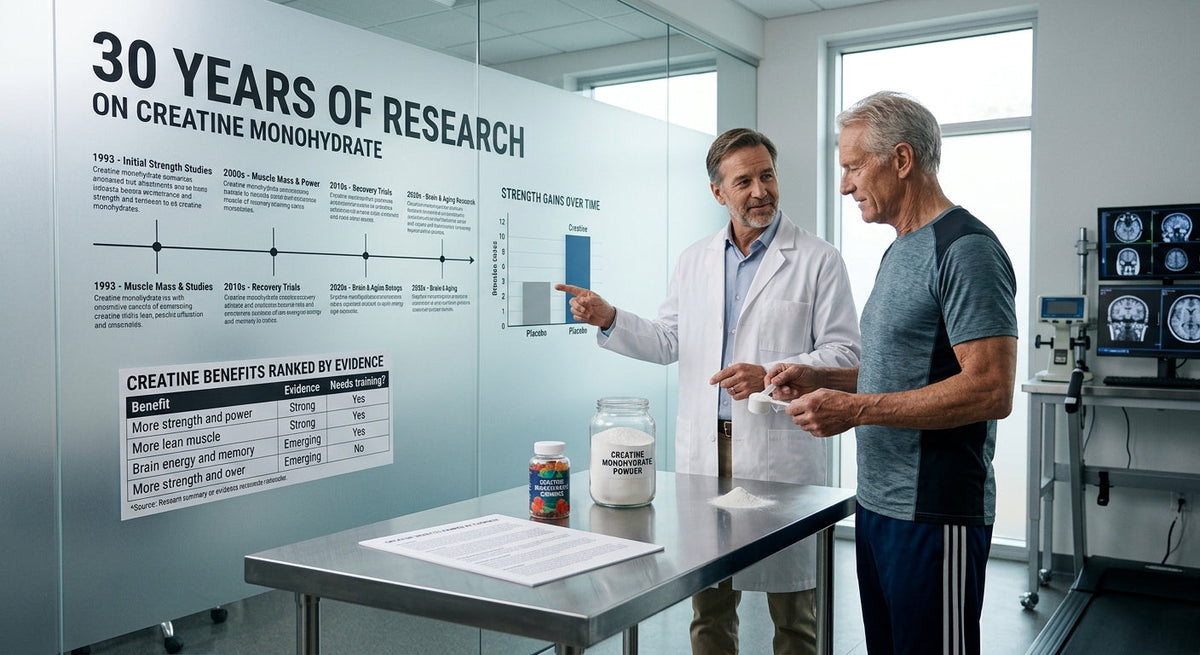
Creatine monohydrate is the most researched sports supplement there is. Hundreds of trials over more than 30 years show that it helps you get stronger and build more muscle when you train. Newer research looks at recovery, aging muscle and the brain. Not all of those benefits are equally proven, so this guide ranks each one by the strength of its evidence. It also covers how much to take, whether it's safe, and how to choose a form.
Short version: take 3–5 g of creatine monohydrate every day, at any time of day, and keep training. That covers almost everyone.
What creatine is and how it works
Creatine is a compound your body makes from three amino acids. You also get it from meat and fish. About 95% of it is stored in your muscles, mostly as phosphocreatine.
Your muscles run on ATP. During hard, short efforts, such as a heavy set, a sprint or a jump, ATP runs out within seconds. Phosphocreatine quickly rebuilds it. A supplement raises your muscle creatine stores, typically by 20–40%, so that fast energy lasts longer. In practice, that can mean an extra rep or two, or a little more power in each sprint. Over weeks of training, those small extras add up.
Your diet supplies about 1–2 g a day if you eat meat and fish. Vegetarians, vegans and many older adults get far less, which is one reason some groups respond more strongly (see below).
Creatine benefits, ranked by strength of evidence
Strong evidence
1. More strength and power. This is the best-established benefit. Together with resistance training, creatine reliably increases maximal strength and power more than training alone. The International Society of Sports Nutrition (ISSN) calls creatine monohydrate the most effective supplement available for increasing high-intensity exercise capacity and lean body mass during training (ISSN position stand, 2017).
2. More lean muscle when you train. People who take creatine while lifting usually gain more lean mass than those who don't. Part of the early gain is water stored inside the muscle cells, which is normal and not "bloat" under the skin. Over longer periods, the extra training volume creatine allows also helps build muscle tissue (Gatorade Sports Science Institute review).
3. Better repeated sprints and intervals. Creatine helps most in efforts that last a few seconds and repeat with short rests: team sports, interval training and circuits. It does little for steady endurance work like a long, easy run.
Moderate evidence
4. Faster recovery between sessions. Several studies report less muscle damage and soreness, and a quicker return of strength, after hard training. A 2026 randomized crossover trial in resistance-trained athletes found better strength, less fatigue and faster recovery with short-term creatine use. It was small, with 10 participants analyzed, so it supports the idea rather than proving it (PMC, 2026).
5. Keeping muscle and strength as you age. After about 40, adults slowly lose muscle and strength. A meta-analysis of older adults found that creatine plus resistance training produced more lean mass and strength than training alone (Chilibeck et al., 2017). A 2025 review of older adults and clinical groups reached a similar conclusion (PMC, 2025). The key word is plus: creatine boosts the effect of training. It is not a substitute for it.
Emerging evidence
6. Brain energy and memory. Your brain also uses phosphocreatine, and supplementing can raise brain creatine modestly. Reviews suggest small improvements in memory and mental processing, most noticeable in older adults and under stress such as sleep deprivation. The research is promising but early. The studies are small, use different doses, and do not all agree. Treat this as a possible bonus, not a reason to take creatine on its own.
7. Women's health. Women have lower creatine stores on average and tend to eat less of it. A 2025 narrative review covers possible benefits across the menstrual cycle, pregnancy research and menopause, mainly for muscle and bone when paired with strength training (PMC, 2025). We cover this in depth in Creatine for Women Over 40.
8. Vegetarians and vegans. People who eat little or no meat start with lower stores, so they often see larger increases in muscle creatine, and in some studies, larger performance and memory effects.
| Benefit | Evidence | Needs training? |
|---|---|---|
| Strength and power | Strong | Yes |
| Lean muscle | Strong | Yes |
| Repeated sprints and intervals | Strong | Yes |
| Recovery | Moderate | Yes |
| Muscle in older adults | Moderate | Yes |
| Memory and brain energy | Emerging | No |
| Women's muscle and bone health | Emerging | Yes |
How much creatine to take
3–5 g a day is the standard dose and what most of the research uses. You have two ways to get to full muscle stores:
- No loading (simplest): 3–5 g every day. Stores fill up in about 3–4 weeks.
- Loading (faster): about 20 g a day, split into four 5 g doses, for 5–7 days, then 3–5 g a day. Stores fill up in about a week. Loading is more likely to cause stomach upset and quick water-weight gain.
Both routes end in the same place. Unless you need results within a week, skip loading.
Timing barely matters. Taking it every day matters far more than when you take it. Some studies suggest a small edge for taking it around your workout, but the difference is minor. Pick a time you'll remember, and take it on rest days too.
If you use gummies, the count depends on how much creatine each gummy contains. See How Many Creatine Gummies Should You Take?
Is creatine safe?
For healthy adults at recommended doses, creatine has an excellent safety record across decades of research. The ISSN position stand concludes that short- and long-term use is safe and well tolerated in healthy people (ISSN, 2017).
- Kidneys: Creatine raises blood creatinine, a lab marker used to estimate kidney function, without harming the kidneys. Tell your doctor you take it before a blood test. If you have kidney disease, don't take creatine without medical advice.
- Hair loss: A 2025 randomized controlled trial found no change in DHT or hair measures after 12 weeks at 5 g a day (Lak et al., JISSN 2025). Read the full breakdown in Does Creatine Cause Hair Loss or Bloating?
- Water weight: Expect about 0.5–1 kg (1–2 lb) in the first weeks, mostly water stored in muscle. This is normal and levels off.
- Stomach upset: This mostly happens with large single doses, as during loading. Smaller doses with food usually prevent it.
Talk to your doctor first if you're pregnant or breastfeeding, under 18, take medicines that affect the kidneys, or have a medical condition.
Who benefits most from creatine?
- People who lift weights or do interval training: they get the clearest gains in strength and muscle.
- Adults over 40: it helps offset age-related muscle loss when paired with strength training.
- Vegetarians and vegans: lower starting stores leave more room to fill.
- Women: lower average stores, plus growing research on muscle and bone.
- Team-sport athletes: they make repeated short, hard efforts.
Endurance athletes training at steady intensity and people who don't exercise will notice the least.
Choosing a form: why monohydrate wins
You'll see creatine HCl, buffered creatine, creatine ethyl ester and others, often at higher prices. Nearly all the research uses creatine monohydrate, and no other form has been shown to work better. Choose monohydrate, then pick the format you'll actually take every day:
- Powder: cheapest per gram, easy to dose precisely, and mixes into water or a shake. Our Creatine Monohydrate Powder gives 5 g per scoop.
- Gummies: convenient and nothing to mix, but they cost more per gram. Check exactly how much creatine each gummy contains. Our Creatine Monohydrate Gummies give 5,000 mg per 4-gummy serving.
- In a pre-workout: covers your daily dose on training days if the product has a full 5 g, as our Pre-Workout with 5 g Creatine does. You'll still need creatine on rest days.
To compare cost, convenience and label accuracy in detail, read Creatine Gummies vs Powder.
Frequently asked questions
How long does creatine take to work?
About a week if you load, or 3–4 weeks at 3–5 g a day. Gains in strength show up over the following weeks of training.
Do I need to cycle off creatine?
No. There's no evidence that cycling helps. If you stop, muscle stores return to baseline over about 4–6 weeks.
Should I take creatine on rest days?
Yes. The goal is to keep muscle stores full, which takes a daily dose.
Does creatine make you gain fat?
No. Creatine has almost no calories. Early weight gain is water stored inside the muscle.
Can I mix creatine with coffee or protein?
Yes. Mixing it into a protein shake is an easy habit. Concerns about caffeine canceling creatine's effects come from a few older studies and aren't consistent; moderate coffee is fine for most people.
Is creatine a steroid?
No. It's a natural compound found in food and made by your body, and it's allowed in all major sports.
The bottom line
Creatine monohydrate has strong evidence for strength, muscle and high-intensity performance, moderate evidence for recovery and healthy aging, and promising early evidence for the brain. Take 3–5 g a day, every day, alongside resistance training, and give it 3–4 weeks.
These statements have not been evaluated by the Food and Drug Administration. This product is not intended to diagnose, treat, cure, or prevent any disease. This article is for general information and isn't medical advice. Talk to your healthcare provider before starting any supplement, especially if you have a medical condition or take medication.