

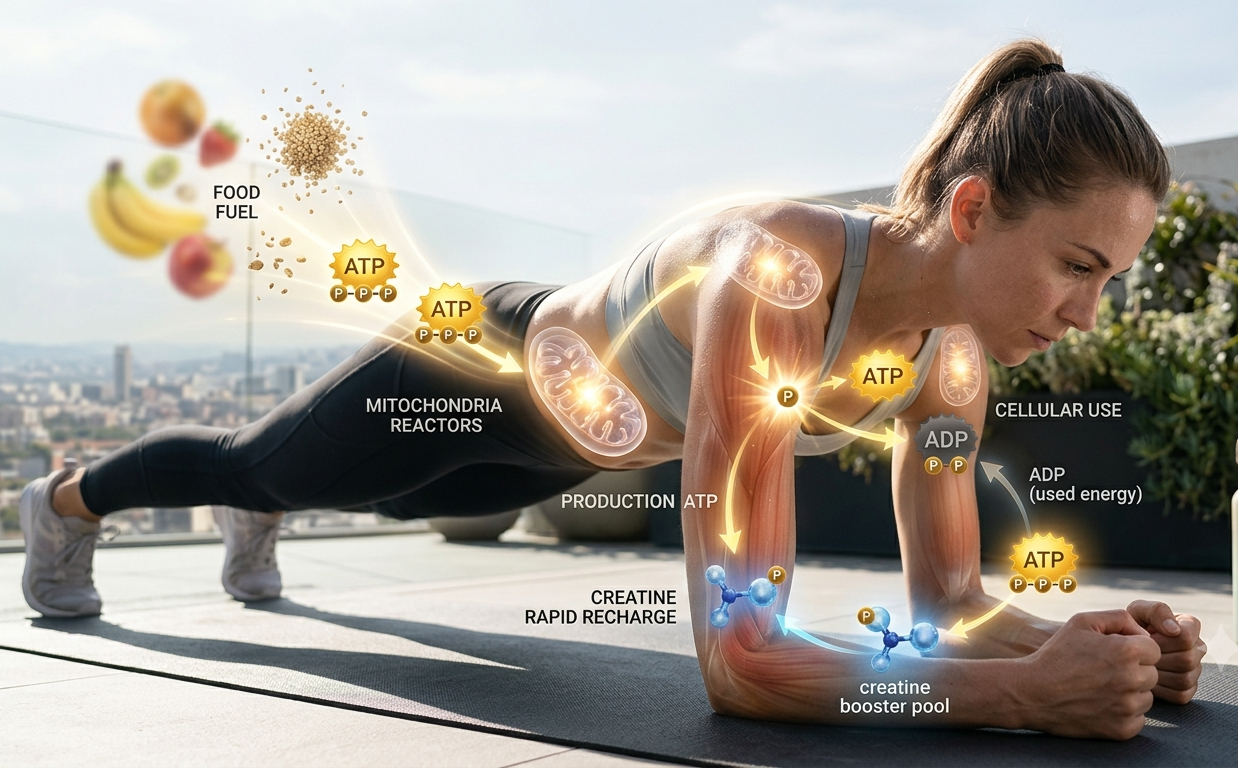
Every action the body performs requires energy. Walking across a room, lifting a grocery bag, focusing on a conversation, digesting a meal, repairing muscle tissue, and maintaining a steady heartbeat all depend on cells having access to usable fuel.
That usable fuel is closely connected to a molecule called adenosine triphosphate, better known as ATP.
ATP is often described as the body’s energy currency because cells use it to power many of the processes required for life. Food contains stored chemical energy, but the body cannot use a meal directly to contract a muscle or send a nerve signal. Nutrients must first be digested, absorbed, transported, and processed through metabolic pathways. Much of the captured energy is then transferred into ATP, which cells can use more immediately.
Understanding ATP helps explain why energy is about more than calories or caffeine. Daily vitality depends on the body’s ability to continually convert nutrients into usable cellular fuel, deliver oxygen, maintain muscle tissue, recover from stress, and regenerate ATP as demands change.
ATP also helps explain the role of creatine. Creatine does not act like a stimulant and does not create energy from nothing. Instead, the creatine–phosphocreatine system helps rapidly recycle ATP during brief periods of high energy demand, such as lifting a weight, climbing stairs quickly, or performing a short burst of physical effort.
For adults over 40, this subject becomes especially relevant because muscle maintenance, exercise capacity, mitochondrial function, nutrition, sleep, and recovery all influence how energetic the body feels. ATP is not the only factor involved in fatigue or vitality, but it sits at the center of the biological processes that allow cells to perform work.
What Does ATP Stand For?
ATP stands for adenosine triphosphate. The molecule contains adenosine - a combination of adenine and a ribose sugar - attached to three phosphate groups.
Those phosphate groups are central to ATP’s role in cellular energy transfer. When a cell needs to perform work, ATP can be broken down into adenosine diphosphate, or ADP, and an inorganic phosphate. This reaction releases usable free energy that can be coupled to cellular processes.
The simplified relationship is often written as:
ATP → ADP + phosphate + usable energy
This description can make ATP sound like a disposable battery, but that is not quite accurate. The body continually rebuilds ATP by adding a phosphate group back to ADP. ATP is therefore used, regenerated, and used again in an ongoing cycle.
Cells do not store an unlimited supply of ATP. The available amount must be continually renewed to match demand. During rest, the body still needs ATP to maintain circulation, breathing, ion balance, tissue repair, brain activity, and temperature regulation. During movement, ATP demand rises because working muscles require additional energy for contraction.
ATP is therefore better understood as a rechargeable cellular energy carrier rather than a large long-term energy reserve.
Why Is ATP Called the Body’s Energy Currency?
Money serves as a common medium of exchange, even when the original resources are very different. ATP plays a somewhat similar role inside cells.
Carbohydrates, fats, and proteins contain chemical energy, but they enter metabolism through different pathways. The body breaks these nutrients down and captures part of their energy in forms that can ultimately support ATP production. ATP then provides a common, readily usable source of energy for many cellular activities.
Muscles use ATP to contract. Nerve cells use it to maintain the electrical gradients required for signaling. Cells use ATP to transport substances across membranes, build proteins, repair structures, and regulate biochemical reactions.
ATP does not create energy. Energy cannot be created from nothing. Instead, ATP temporarily stores and transfers chemical-free energy released as nutrients are metabolized.
This distinction matters because phrases such as “boosting ATP” are sometimes used loosely in wellness marketing. ATP metabolism is not a simple dial that can be turned up indefinitely. It is a tightly regulated system connected to nutrient availability, oxygen delivery, cellular demand, mitochondrial function, and recovery.
A healthy energy strategy, therefore, supports the overall process rather than promising unlimited cellular power.
How Does the Body Produce ATP?
The body produces ATP through several interconnected energy systems. Which system contributes most depends on the intensity and duration of the activity, the fuel available, and the tissues involved.
The three major systems commonly discussed in exercise physiology are the phosphagen system, glycolysis, and oxidative metabolism. They are often taught separately for clarity, but they work together rather than switching on and off in isolation.
The Phosphagen System
The phosphagen system supplies ATP rapidly during very brief, high-demand activity. It relies heavily on phosphocreatine stored in muscle cells.
When ATP is broken down into ADP, phosphocreatine can donate a phosphate group to ADP, rapidly restoring ATP. This reaction is supported by an enzyme called creatine kinase.
The system is especially important during activities such as a short sprint, a heavy lift, a quick jump, or the first seconds of climbing stairs rapidly. It can provide energy very quickly, but its capacity is limited because muscle stores only a certain amount of phosphocreatine.
Glycolysis
Glycolysis breaks glucose into smaller molecules in the fluid portion of the cell. It can generate ATP relatively quickly and does not require oxygen directly during the glycolytic steps.
Glycolysis supports many activities, especially when energy demand exceeds what oxidative metabolism can meet immediately. It also produces pyruvate, which can enter the mitochondria and contribute to additional ATP production when oxygen and metabolic conditions allow.
Glycolysis produces far less ATP from each glucose molecule than complete oxidative metabolism, but its ability to respond quickly makes it valuable.
Oxidative Metabolism
Most ATP used during lower-intensity, sustained activity and ordinary cellular function is produced through oxidative metabolism. This process occurs largely within mitochondria and uses oxygen to help extract energy from carbohydrates, fats, and, under some circumstances, amino acids.
Oxidative metabolism is slower than the phosphagen system, but it can provide much larger amounts of ATP over time. It supports walking, cycling, daily movement, organ function, recovery, and many other ongoing processes.
These systems overlap. During a workout, for example, the phosphagen system may contribute strongly at the start of a set, glycolysis may become more prominent as effort continues, and oxidative metabolism helps restore energy between efforts and supports longer-duration activity.
How Food Becomes Cellular Energy
Food does not turn directly into ATP in one step. Digestion breaks down carbohydrates, fats, and proteins into smaller components that can enter metabolism.
Carbohydrates are broken down primarily into simple sugars, including glucose. Glucose can enter glycolysis, producing a small amount of ATP and pyruvate. Under aerobic conditions, pyruvate can be converted into acetyl-CoA and enter the citric acid cycle inside mitochondria.
Fats are broken into fatty acids and glycerol. Fatty acids can undergo beta-oxidation, producing acetyl-CoA and other molecules that contribute to mitochondrial ATP production.
Proteins are broken down into amino acids. Their primary role is not simply to provide energy; amino acids are needed for muscle tissue, enzymes, signaling molecules, immune proteins, and repair. Under certain conditions, however, amino acids can also enter metabolic pathways associated with energy production.
These fuel pathways eventually contribute electrons to the mitochondrial electron transport chain. The energy carried by those electrons helps create a proton gradient across the inner mitochondrial membrane. ATP synthase then uses the gradient to add a phosphate group to ADP, producing ATP.
The full process is complex, but the practical message is straightforward: the body converts nutrients into usable cellular fuel through a coordinated series of reactions involving digestion, circulation, enzymes, mitochondria, oxygen, and cellular demand.
What Role Do Mitochondria Play?
Mitochondria are specialized structures inside most human cells. They are often called the powerhouses of the cell because they produce much of the ATP that supports cellular activity.
That phrase is helpful, but mitochondria do more than manufacture ATP. They are also involved in metabolic signaling, calcium regulation, cellular stress responses, and other essential processes.
Different tissues contain different numbers and types of mitochondria depending on their energy requirements. Heart muscle, skeletal muscle, the brain, and other active tissues have substantial energy demands and rely heavily on mitochondrial function.
Mitochondria use products derived from carbohydrates, fats, and proteins to support the citric acid cycle and electron transport chain. Oxygen serves as the final electron acceptor in oxidative phosphorylation, allowing the system to continue producing ATP efficiently.
This is why circulation, lung function, cardiovascular fitness, and blood health all matter for energy. Nutrients alone are not enough; cells also need oxygen delivery and functioning metabolic machinery.
Regular physical activity can signal to skeletal muscle to improve its oxidative capacity. Aerobic exercise is especially associated with adaptations that help muscles use oxygen and fuel more effectively. Strength training also supports metabolically active muscle tissue and can complement aerobic activity within an energy-focused routine.
Related article: How Exercise Supports Energy After 40
How Is ATP Used During Muscle Contraction?
Muscle contraction depends on interactions between proteins called actin and myosin. ATP binds to myosin and participates in the cycle that allows muscle fibers to generate force.
ATP is also required for muscle relaxation. Calcium ions help initiate contraction, and ATP-dependent pumps return calcium to its storage sites within muscle cells when the contraction ends.
This is an important reminder that energy is required not only to move but also to reset the system for the next movement.
During exercise, ATP demand can rise dramatically. Stored ATP supports only a very brief period of maximal effort, so the body immediately begins regenerating it through the phosphagen, glycolytic, and oxidative systems.
Training improves the body’s ability to meet these demands. A stronger, better-conditioned person may perform a familiar task at a lower percentage of their maximum capacity, making the activity feel less exhausting.
What Is the ATP–ADP Cycle?
ATP becomes ADP when one phosphate group is removed. The cell then uses energy from nutrient metabolism to add the phosphate back, regenerating ATP.
This repeating ATP–ADP cycle occurs continuously.
It can be compared to using and recharging a rechargeable battery, although the biological system is far faster and more complex. The body turns over a substantial amount of ATP each day, even though only a relatively small quantity is present at any one time.
The cycle must respond to changing demand. When muscle activity increases, ATP breakdown accelerates. Rising ADP and other signals stimulate energy-producing pathways, allowing ATP to be regenerated.
When activity decreases, demand falls, but ATP remains essential for basic cellular function and recovery.
The balance between ATP use and ATP regeneration is one of the central principles of bioenergetics.
How Does Creatine Help Recycle ATP?
Creatine participates in one of the body’s fastest ATP-regeneration systems.
Most of the body’s creatine is stored in skeletal muscle, either as free creatine or as phosphocreatine. Phosphocreatine contains a high-energy phosphate group.
When ATP is used and becomes ADP, phosphocreatine can donate its phosphate group to ADP. The enzyme creatine kinase helps facilitate the reaction:
Phosphocreatine + ADP → creatine + ATP
This does not produce new energy from nothing. It transfers a stored phosphate so ATP can be rapidly regenerated.
The system is especially valuable during brief periods when ATP demand rises faster than oxidative metabolism can respond. Examples include lifting a heavy weight, accelerating into a sprint, jumping, or completing repeated high-intensity efforts.
Phosphocreatine also helps shuttle high-energy phosphate groups between mitochondria and sites in the cell where ATP is used. For that reason, the creatine kinase system is often described as an energy buffer or shuttle.
Where Does Creatine Come From?
The body can synthesize creatine from amino acids, primarily through processes involving the liver, kidneys, and other tissues. Creatine is also obtained through foods, especially meat and fish.
Dietary intake varies. People who eat little or no animal-derived food generally consume less preformed creatine than people who regularly eat meat or fish, although the body still produces its own.
Creatine supplements increase the amount of creatine and phosphocreatine stored in muscle for many individuals. This can improve the ability to regenerate ATP during repeated short, high-intensity efforts.
Creatine monohydrate is the most extensively researched form. Its strongest established uses relate to repeated high-intensity exercise, strength, power, and training performance.
Creatine should not be portrayed as an instant cure for generalized fatigue. It does not replace sleep, nutrition, medical evaluation, or exercise. Its role is specific: supporting the phosphocreatine energy system and, when paired with resistance training, helping improve training capacity and muscular outcomes for many people.
Learn more: Creatine Benefits After 40
Explore: NaturaVivo Creatine Monohydrate Powder
Does Creatine Increase ATP?
Creatine supplementation does not create an unlimited supply of ATP. Instead, it can increase muscle creatine and phosphocreatine stores, providing greater capacity for rapid ATP regeneration during short periods of high demand.
The distinction is important.
Creatine is most useful when the body rapidly needs ATP, such as during resistance training or sprint-type activity. It is generally less useful as a direct performance aid for long-duration, steady endurance exercise.
Over time, better training quality may support strength and muscle maintenance. Those changes can make daily activities feel easier and contribute to a broader sense of physical energy.
Creatine is therefore best viewed as a training-support nutrient rather than a stimulant.
Why ATP Matters More After 40
ATP remains essential at every age. The molecule itself does not suddenly change at 40, but several factors affecting cellular energy and physical capacity may gradually evolve during midlife.
Muscle mass may decline when it is not actively maintained. Physical activity may decrease because of work demands, joint discomfort, or habit. Sleep may become lighter. Hormonal transitions can influence recovery, appetite, body temperature, and body composition. Stress may remain elevated for longer periods.
These factors can make daily energy feel less predictable. They can also reduce the body’s margin for poor sleep, inadequate food, dehydration, or inactivity.
Supporting ATP production after 40 is not about finding a single “energy molecule” supplement. It means supporting the systems that continually regenerate ATP: healthy mitochondria, active muscle, adequate oxygen delivery, balanced nutrition, hydration, and recovery.
The most effective strategy is therefore broader than creatine alone. Creatine may complement the system, particularly for people doing resistance training, but it works best within a lifestyle that provides the conditions the body needs to produce and use energy.
Explore the pillar guide: Energy and Metabolic Health After 40
How Exercise Supports ATP Production
Exercise is one of the most powerful signals for cellular adaptation.
Aerobic activity places repeated demand on oxidative metabolism. Over time, skeletal muscle can adapt by improving mitochondrial density, enzyme activity, capillary supply, and the ability to use oxygen and fuel.
Resistance training challenges the phosphagen and glycolytic systems while stimulating strength and muscle adaptation. It also helps preserve the tissue that consumes and stores energy substrates.
These changes do not mean a fit person permanently stores enormous amounts of ATP. Instead, training improves the body’s ability to regenerate ATP and perform work efficiently.
A combination of aerobic activity, resistance training, mobility work, and daily movement provides a comprehensive approach. Public health guidance generally encourages adults to engage in regular aerobic and muscle-strengthening exercise, but anyone beginning at a low activity level can benefit from starting gradually.
A ten-minute walk, two short strength sessions per week, or brief movement breaks during the workday can all help establish the pattern. Progress matters more than perfection.
How Sleep Influences Cellular Energy
Sleep does not directly “fill up” an ATP tank in a simple way, but it supports the systems that regulate energy, repair tissues, manage stress, and prepare the body for the next day.
During sleep, the body coordinates hormonal activity, nervous-system recovery, memory processing, immune function, and tissue maintenance. Poor sleep can make exercise feel harder, reduce motivation, impair concentration, and increase perceived fatigue.
Repeated sleep disruption may also affect glucose regulation, appetite, and recovery. These changes can indirectly influence how effectively the body manages fuel and physical activity.
Adults who wake frequently, snore loudly, experience night sweats, or remain excessively sleepy despite adequate time in bed should consider whether a sleep problem needs professional evaluation.
Related article: How Sleep Changes During Midlife
How Nutrition Supports ATP Production
ATP production depends on nutrients because metabolic pathways require both fuel and cofactors.
Carbohydrates can provide glucose for glycolysis and oxidative metabolism. Dietary fats provide fatty acids that can support sustained energy production. Protein supplies amino acids needed for tissues, enzymes, and repair, while some amino acids can also enter energy pathways.
Vitamins and minerals participate in numerous metabolic reactions. B vitamins, for example, serve as components of coenzymes involved in the processing of carbohydrates, fats, and proteins. Magnesium is associated with ATP in cells and supports many enzyme reactions.
This does not mean taking large doses of individual nutrients will automatically generate more energy. When nutritional status is already adequate, more is not necessarily better. Deficiencies should be identified and addressed appropriately rather than assumed.
Balanced meals containing protein, minimally processed carbohydrates, healthy fats, vegetables, fruits, and adequate fluids provide a strong foundation.
Protein products can offer convenience for adults trying to maintain muscle or meet increased needs related to training, but they should complement a varied diet.
Explore: NaturaVivo Protein and Performance Products
Why Hydration Matters
Water supports circulation, nutrient transport, temperature regulation, digestion, and the chemical environment in which metabolic reactions occur.
Dehydration can reduce exercise performance, contribute to headaches, and make concentration more difficult. When circulation and temperature regulation are under strain, physical effort may feel harder.
Hydration needs vary according to body size, climate, diet, exercise, sweat rate, medications, and health conditions. A practical strategy is to drink regularly throughout the day, pay closer attention during periods of heat and exercise, and avoid relying solely on thirst after extended distraction.
People with kidney, heart, or fluid-balance conditions should follow individualized professional advice.
Water does not supply ATP directly, but it supports the environment in which ATP-producing and ATP-using processes function.
Can Caffeine Increase ATP?
Caffeine can improve alertness and may enhance some aspects of exercise performance, but it does not function like ATP or creatine.
Caffeine primarily affects the nervous system by blocking adenosine receptors, which can temporarily reduce the perception of tiredness. It may help someone feel more awake, but it does not correct poor sleep, inadequate nutrition, anemia, thyroid problems, or other underlying causes of fatigue.
Excessive or late caffeine can also interfere with sleep, creating a cycle of temporary stimulation followed by poorer recovery and greater fatigue the next day.
This is why true cellular-energy support should not be confused with feeling stimulated. ATP production, mitochondrial function, creatine metabolism, and caffeine alertness are related to “energy” in different ways.
ATP and Perceived Energy Are Not the Same Thing
A person can have normal cellular ATP production and still feel tired. Perceived energy is influenced by sleep, mood, stress, illness, medication, motivation, pain, fitness, hydration, and nutrition.
Similarly, someone may feel temporarily alert after caffeine even though the body remains under-recovered.
This distinction prevents ATP from becoming an overly simple explanation for every experience of fatigue.
ATP is indispensable for cellular work, but fatigue is a whole-body symptom. Persistent tiredness should not automatically be blamed on low ATP or treated only with supplements.
The most responsible approach considers both cellular physiology and the wider context of health.
A Practical Routine That Supports Cellular Energy
Supporting cellular energy does not require controlling every biochemical reaction.
Start with movement. Regular aerobic activity challenges oxidative metabolism, while resistance training supports strength and muscle tissue. Break up long periods of sitting with short walks or mobility work.
Build meals around adequate protein, fiber-rich carbohydrates, healthy fats, and nutrient-dense foods. Avoid relying on sugar or stimulants as the primary answer to fatigue.
Hydrate consistently and pay attention to increased needs during exercise and heat.
Protect sleep by maintaining a regular schedule, reducing late caffeine, creating a cool environment, and limiting evening stimulation.
Manage training stress. Hard workouts require recovery. More exercise is not always more productive when sleep and nutrition are inadequate.
Creatine may be considered as a targeted addition for adults participating in resistance training or repeated high-intensity activity. CoQ10 and other products may fit different wellness goals, but they should be positioned within an education-first routine rather than as replacements for fundamental habits.
Supporting ATP Through the NaturaVivo Ecosystem
NaturaVivo’s Energy and Metabolic Health ecosystem is designed to help readers move from basic understanding to practical action.
The Energy and Metabolic Health After 40 pillar explains how ATP, mitochondria, metabolism, muscle, sleep, stress, and nutrition work together.
Why Do People Feel More Tired After 40? explores common reasons energy may change during midlife. How Exercise Supports Energy After 40 explains how movement trains the body’s energy systems. How Metabolism Evolves With Age connects energy production with muscle, hormones, and activity.
The Creatine Benefits After 40 guide provides focused ingredient education, while NaturaVivo’s creatine and protein products offer practical options for adults building strength- and performance-support routines.
This structure creates a clear pathway:
Question → education → lifestyle application → informed product choice
Supporting Your Strength and Cellular-Energy Routine
Energy after 40 should not depend entirely on stimulants or temporary motivation. Sustainable vitality comes from supporting the systems that allow the body to create and recycle ATP.
Regular movement increases demand and encourages adaptation. Resistance training supports muscle. Balanced nutrition supplies fuel and cofactors. Hydration supports circulation and metabolism. Sleep allows recovery. Creatine can complement the rapid ATP-recycling system during demanding muscular activity.
NaturaVivo Creatine Monohydrate Powder is designed for adults who want a straightforward way to add creatine to a consistent strength and performance routine.
Explore NaturaVivo Creatine Monohydrate Powder
Explore Energy and Performance Support
Dietary supplements are intended to complement, not replace, balanced nutrition and healthy lifestyle habits. Consult a qualified healthcare professional before beginning supplementation when pregnant, managing a medical condition, taking medication, or unsure whether a product is appropriate.
The Final Takeaway
ATP is the molecule cells use to transfer usable energy for movement, nerve signaling, transport, repair, and countless other biological processes.
The body continually regenerates ATP from ADP using energy derived from food. Mitochondria produce much of the ATP used during sustained activity and ordinary cellular function. Glycolysis contributes more rapidly, while the phosphocreatine system helps recycle ATP during brief periods of intense demand.
Creatine supports this rapid recycling process by helping maintain phosphocreatine stores in muscle. It does not create unlimited energy, replace sleep, or act as a stimulant. Its value is strongest as part of a consistent exercise routine, particularly one that includes resistance training or repeated high-intensity effort.
After 40, ATP remains the same essential molecule it has always been. What may change are the systems surrounding it: muscle mass, physical activity, sleep, hormones, stress, nutrition, and recovery.
Supporting cellular energy, therefore, means supporting the whole body.
Move regularly. Maintain muscle. Eat balanced meals. Hydrate. Protect sleep. Recover intentionally. Use targeted supplements thoughtfully.
ATP may be microscopic, but the systems that sustain it shape nearly every moment of human activity.